





Pharmacovigilance Outsourcing Services: How and when Global Pharma, Biotech, and CROs Strengthen Safety, Compliance, and Regulatory Success
In today’s highly regulated environment, pharmacovigilance outsourcing services have become a strategic necessity for pharmaceutical companies, biotech organizations, sponsors, and CROs operating across the US, EU, UK, and APAC markets. As safety data volumes increase and global regulatory expectations evolve, companies are increasingly seeking pharmacovigilance consulting services and drug safety consulting services that provide both operational excellence and regulatory confidence.
Organizations that rely solely on internal resources often face challenges such as delayed submissions, inconsistent data quality, inspection findings, and inefficient workflows. This is why many global companies now partner with specialized providers offering end-to-end pharmacovigilance outsourcing services, pharmacovigilance compliance consulting, and pharmacovigilance audit services.
This article explains why pharmacovigilance outsourcing is critical, what services buyers should prioritize, and how the right pharmacovigilance service provider can significantly improve inspection readiness, signal detection capability, and regulatory success.
Why Pharmacovigilance Outsourcing Services Are Increasing Globally
The demand for pharmacovigilance outsourcing services continues to grow because companies must manage:
Increasing global safety reporting requirements
Complex aggregate reporting obligations
Growing expectations for benefit-risk evaluation
Rising inspection readiness standards
Maintaining global compliance requires not only operational execution but also strategic oversight, which is why companies increasingly invest in pharmacovigilance consulting services and drug safety consulting services that combine medical expertise, regulatory knowledge, and quality governance.
Outsourcing to specialized providers offering pharmacovigilance compliance consulting enables organizations to maintain consistent safety data quality, strengthen benefit-risk assessment frameworks, and ensure timely regulatory submissions.
Core Services Companies Seek in Pharmacovigilance Outsourcing – Why should Companies Choose GPLACO SOLUTIONS?
1. ICSR Case Processing and Safety Operations –
ICSR case processing is one of the most frequently outsourced pharmacovigilance activities globally. While many CROs and consulting firms focus primarily on service delivery and volume handling, experienced sponsors, MAHs, and biotech companies know that ICSR quality—not speed alone—determines regulatory outcomes.
This is where GPLACO SOLUTIONS is fundamentally different.
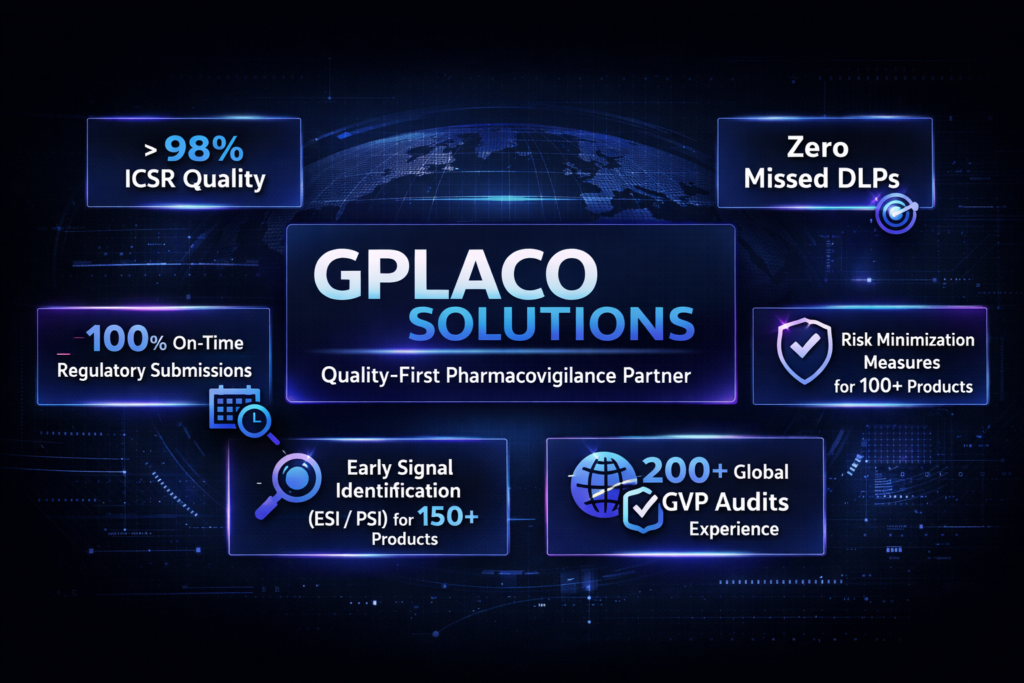
With 18+ years of deep, hands-on pharmacovigilance experience, we do not wait for quality issues to surface. On Day 1, we implement a Quality Improvement Plan (QIP)—before errors, rework, or regulatory queries begin. Our approach is built on lessons learned from 200+ global GVP and PV audits, allowing us to anticipate inspection expectations and regulator focus areas in advance.
Unlike large CROs, where case processing is often fragmented across teams and geographies, GPLACO SOLUTIONS implements tried-and-tested global ICSR workflows for:
Clinical trial safety reporting
Spontaneous and post-marketing cases
Literature-derived ICSRs
Global expedited and non-expedited submissions
We redesign workflows to eliminate root causes of quality failures, not just correct them after the fact. This results in consistent ICSR data accuracy approaching 98%, reduced follow-up queries, and improved downstream signal detection and benefit-risk assessment.
Our clients do not engage us simply for processing capacity. They engage GPLACO SOLUTIONS because they want:
Fewer quality escalations
Predictable regulatory timelines
Inspection-resilient case documentation
Reduced cost of rework and remediation
By combining robust global PV QMS implementation, effective workflow governance, and continuous quality monitoring, we ensure that ICSR case processing supports—not undermines—your overall safety strategy.
In short, GPLACO SOLUTIONS does not behave like a traditional CRO or consulting vendor. We act as a strategic pharmacovigilance partner, solving quality and compliance challenges before they consume time, budget, and regulatory credibility.
2. Signal Detection, Validation, and Risk Evaluation – A Proactive Intelligence Model
Signal detection is often treated as a routine regulatory requirement by many outsourcing providers, relying heavily on automated statistical outputs without deep medical interpretation. However, regulators increasingly expect clinically meaningful signal validation, documented decision-making, and proactive risk evaluation, not just tool-generated alerts.
GPLACO SOLUTIONS operates differently.
Drawing from 18+ years of global pharmacovigilance leadership and extensive audit exposure, we establish end-to-end signal management frameworks that combine statistical detection, expert medical validation, and structured governance oversight. Our signal workflows are designed based on real inspection observations and global expectations under ICH E2E and GVP Module IX, ensuring that signal detection activities withstand regulatory scrutiny.
Unlike traditional CRO models that operate in functional silos, we integrate:
ICSR trends
Literature intelligence
Aggregate report findings
Risk management commitments
into a unified global signal tracking and validation system.
Clients choose GPLACO SOLUTIONS because we do not simply detect signals—we ensure signals are correctly interpreted, documented, escalated, and resolved, strengthening regulatory confidence and minimizing unexpected authority queries.
3. Aggregate Safety Reports (PSUR / PBRER / DSUR) – Inspection-Ready Scientific Reporting
Many organizations face recurring challenges in aggregate reporting, including delayed data lock readiness, inconsistent medical evaluation narratives, and increased health authority questions. Traditional outsourcing providers frequently focus on report compilation rather than scientific quality, cross-functional alignment, and submission readiness.
GPLACO SOLUTIONS addresses these challenges from the beginning of the reporting cycle.
Based on global regulatory experience and multiple inspection-driven remediation programs, we implement Data Lock Point (DLP) readiness frameworks, structured authoring governance, and medically driven benefit-risk evaluation methodologies. This ensures:
On-time aggregate submissions
Consistent global regulatory positioning
Scientifically robust benefit-risk conclusions
Our approach reduces last-minute reporting pressure and prevents quality deviations that often lead to regulatory follow-up queries. Sponsors and MAHs partner with GPLACO SOLUTIONS not just for writing support, but for strategic reporting governance that improves approval pathways and long-term product safety positioning.
4. Risk Management Plans (RMP) and Risk Minimization Strategies – From Compliance to Strategic Risk Control
For many organizations, Risk Management Plans are developed primarily as submission documents rather than as living risk-governance frameworks. This results in implementation gaps, weak effectiveness evaluation strategies, and post-approval regulatory findings.
GPLACO SOLUTIONS transforms RMP development into a proactive safety strategy.
Leveraging global regulatory expertise across EU-RMP, REMS, and additional Risk Minimization Measures (aRMMs), we design risk characterization and mitigation frameworks that are practical, measurable, and globally implementable. Our experience from numerous regulatory inspections and PV system audits enables us to identify risk-management gaps early and implement corrective strategies before they become compliance risks.
Clients rely on GPLACO SOLUTIONS because we ensure that risk management activities are operationally executable, inspection-defensible, and aligned with real-world safety monitoring requirements, not merely document-centric deliverables.
5. Pharmacovigilance System Master File (PSMF) – True Inspection Readiness
Many companies maintain PSMFs primarily to meet documentation requirements, updating them periodically without aligning operational practices with the declared PV system structure. This mismatch is one of the most common inspection findings globally.
GPLACO SOLUTIONS applies an inspection-backward design approach to PSMF development and maintenance.
Using insights from 200+ global PV and GVP audits, we ensure that the PSMF reflects the actual functioning pharmacovigilance system, including governance structures, vendor oversight, QMS processes, and operational workflows. We also implement continuous update mechanisms to maintain inspection readiness across regulatory regions.
Organizations partner with GPLACO SOLUTIONS because our PSMF frameworks do not just satisfy submission requirements—they ensure that the entire PV system stands inspection-ready at any time.
6. PV Audits, Vendor Qualification, and Global PV QMS Implementation – Building Compliance That Lasts
Traditional audit approaches often identify findings but do not systematically address the underlying process failures that cause recurring compliance risks. Similarly, vendor qualification is frequently treated as a procedural checklist rather than a risk-based compliance safeguard.
GPLACO SOLUTIONS delivers a fundamentally different model.
With experience from 200+ global GVP and PV audits, we implement risk-based PV QMS frameworks, vendor qualification governance, and inspection-aligned remediation programs designed to eliminate root-cause compliance failures. Our audit methodology focuses not only on regulatory adherence but also on workflow resilience, data quality governance, and operational scalability across global markets.
Clients choose GPLACO SOLUTIONS because we help them move beyond reactive compliance toward sustainable inspection readiness, ensuring fewer regulatory observations, stronger vendor oversight, and globally harmonized pharmacovigilance systems.
How the Right Pharmacovigilance Consulting Partner Creates Strategic Value
Choosing the right pharmacovigilance outsourcing services provider is not only about operational support; it is about enabling long-term safety governance and regulatory success. Companies that partner with experienced providers offering drug safety consulting services benefit from:
Reduced regulatory risks
Improved safety data quality
Stronger inspection readiness
Faster submission timelines
Global regulatory alignment
Enhanced signal detection capability
Strategic providers delivering pharmacovigilance consulting services, signal detection services pharmacovigilance, aggregate safety report writing services, and pharmacovigilance audit services help companies transform pharmacovigilance from a compliance function into a strategic safety intelligence framework.
Key Considerations When Selecting Pharmacovigilance Outsourcing Services
Before selecting a partner for pharmacovigilance outsourcing services, organizations should evaluate:
Global regulatory expertise (FDA, EMA, MHRA, TGA)
Experience delivering pharmacovigilance audit services
Signal detection and benefit-risk evaluation expertise
Aggregate report writing and submission support capabilities
PV QMS implementation and compliance consulting
Scalability of pharmacovigilance operations
Selecting providers offering comprehensive pharmacovigilance consulting services and drug safety consulting services ensures continuity of compliance and operational stability across global markets.
The Future of Pharmacovigilance Outsourcing: Strategic Safety Transformation
The future of global pharmacovigilance is shifting toward integrated safety intelligence models supported by automation, advanced analytics, and proactive risk management. Organizations that invest in strategic pharmacovigilance outsourcing services, signal detection services pharmacovigilance, aggregate safety report writing services, and pharmacovigilance audit services are better positioned to meet evolving regulatory expectations.
Companies adopting a proactive approach to pharmacovigilance compliance consulting and global safety governance will achieve faster approvals, stronger regulatory relationships, and sustainable patient safety outcomes.
Conclusion
Across all pharmacovigilance functions—from ICSR operations to signal detection, aggregate reporting, RMPs, PSMF management, and PV audits—organizations today require more than service delivery. They need strategic partners who can anticipate regulatory expectations, improve quality before failures occur, and implement globally scalable pharmacovigilance systems.
This is the difference GPLACO SOLUTIONS brings:
audit-proven experience, prevention-focused quality frameworks, and execution models designed to protect regulatory credibility while accelerating operational efficiency.